How to Plan Your Immigration Process with Confidence
Learn how to start a U.S. immigration case with the right strategy, documents, timing, and support, so you can move forward with more confidence.

You do not start a U.S. immigration case by filling out forms at random. You start by choosing the right legal path, matching it to your facts, and building a document plan before any filing happens. If you are a family sponsor, a skilled professional, an investor, or a self-petitioner, this guide shows how to move forward with more clarity, fewer delays, and stronger evidence.
For most people, confidence comes from structure. That means understanding which agency does what, which petition starts the case, whether you will process inside or outside the United States, and what proof must be ready before deadlines arrive. For readers working on a complex professional or business-based case, Seeder Visa Solutions can help turn qualifications and goals into documentation that is coherent, persuasive, and easier for counsel to use.
The most important planning points before you file anything
- Your category determines everything: eligibility, forms, evidence, cost, and timing change depending on whether the case is family-based, employment-based, investor-based, or self-petitioned.
- The first filing is rarely the whole case: many processes begin with a petition, then move to visa processing abroad or status adjustment inside the United States.
- Documents cause many delays: missing civil records, weak translations, inconsistent dates, and poor evidence organization can slow a case even when the applicant is eligible.
- Government roles are different: USCIS decides many petitions and applications, while consulates and the National Visa Center handle major parts of immigrant visa processing abroad.
- Good strategy saves time: a strong file is not just complete, it is sequenced correctly, supported by the right evidence, and aligned with the legal standard.
The first decision is not the form, it is the immigration route
The smartest way to begin is to identify the route that legally fits your situation. People often search for the first form, but the form only makes sense after you know the category, sponsor, and final objective. A permanent move through family sponsorship works very differently from an employment-based visa, an E-2 investment case, or an EB-2 NIW self-petition.
According to federal visa guidance from USAGov, immigrant pathways commonly include family-based and employment-based options, while other routes such as fiancé(e), diversity, and humanitarian cases follow their own rules and steps. If you are trying to understand the broader immigration process to America, the key is to stop thinking in generic terms and map your case to one specific legal channel.
This is also where many expensive mistakes happen. People assume a friend’s timeline, a social media checklist, or a lawyer’s other client is relevant to them, when the real question is much narrower: what exact category, statute, and evidence standard applies to your facts?
What government agencies actually do in your case?
You will plan better once you separate the roles of the agencies involved. USCIS handles many petitions and applications inside the immigration system, while the Department of State manages consular visa processing abroad. That distinction matters because the same person can interact with more than one government body in the same case.
The difference between USCIS and immigration services in the private market is especially important. USCIS is the government decision-maker for many filings, while private immigration providers may help with strategy, document assembly, writing support, translation coordination, or legal representation depending on who they are and what they are authorized to do. The American Immigration Council’s system overview also explains that some categories begin with a sponsor or employer petition, while some applicants can self-petition.
This matters in practical terms. If you ask, “Who should I contact first?”, the answer may be a family sponsor, an employer, an attorney, or a documentation specialist, not a government hotline. Planning is about sequencing those roles so each person contributes at the right stage.
Most immigration cases start with a petition, not a visa interview
For many permanent immigration cases, the first formal step is a petition that establishes the relationship or eligibility basis. A U.S. citizen may file for a relative, an employer may file for a worker, or a professional may qualify to self-petition in a category that allows it. The interview or final application usually comes later.
The U.S. government’s immigrant visa overview states that family-based and work-based immigrant visas each have their own application requirements and sponsorship structure. Travel.State.gov further explains, in its National Visa Center processing guidance, that after petition approval and visa availability, applicants are directed to continue pre-processing, fee payment, and document submission.
That sequence is why rushing to collect random papers rarely helps. The better move is to identify the petition first, confirm whether a visa number must be available, and only then build the evidence set that supports the next phase.
Will you adjust status in the U.S. or process at a consulate abroad?
This is one of the biggest fork-in-the-road decisions in the whole process. If you are lawfully in the United States and eligible, you may be able to apply through adjustment of status. If you are outside the country, or your case requires overseas processing, your petition may move through the National Visa Center and then to a consulate.
Travel.State.gov explains in its immigrant visa processing FAQs that approved petitions for applicants seeking a visa outside the United States are sent to the National Visa Center, which then handles fee collection and document intake before the consular stage. For readers trying to make sense of the immigration legal process, this is a core concept because the procedural path changes the forms, timeline, interview location, and preparation strategy.
Do not guess here. A wrong assumption about where your case should be processed can create delays, extra expense, or in some cases a filing that should never have been made. This is one of the moments when individualized legal review is often worth it.

What documents should you prepare before filing?
The best answer is: more than the bare minimum, but only the right ones. Immigration cases live or die on consistency, credibility, and completeness. You should expect to gather identity records, civil status records, immigration history, financial evidence, and category-specific proof such as relationship evidence, employment records, or proof of investment and business viability.
Travel.State.gov notes in its financial and supporting document guidance that applicants and sponsors may need financial evidence, civil documents, and proof of status, and that tax transcripts are strongly recommended in many affidavit of support situations. If you need help with immigration paperwork because records are inconsistent, incomplete, or poorly organized, that is not a cosmetic issue. It is often the exact reason a solid case becomes harder than it should be.
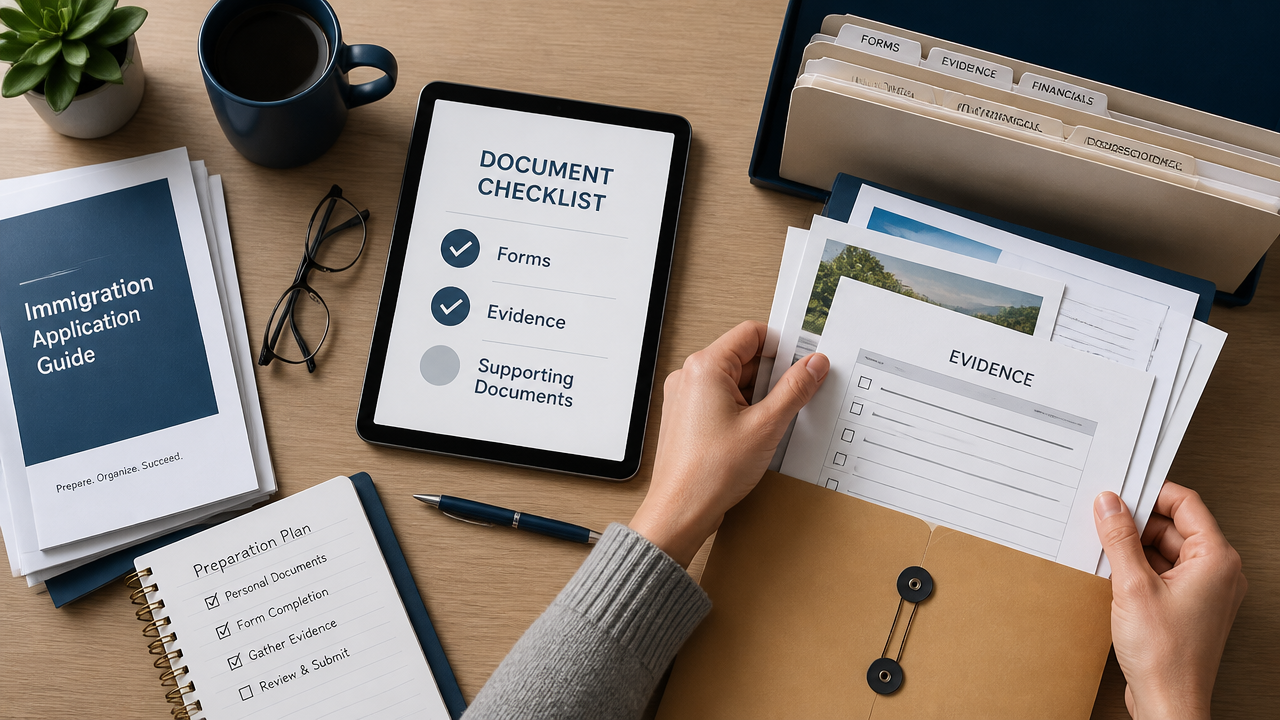
Before filing, create a document map with four columns:
- Required item
- Who provides it
- Acceptable format and translation needs
- How it supports the legal standard
That last column is the one many applicants skip. Immigration evidence is not just paperwork. It is proof with a purpose.
How long does the immigration process usually take?
The honest answer is that timing depends on category, visa availability, country-specific demand, government workload, document quality, and whether your case hits extra review. There is no single “normal” timeline that applies to everyone. A family case, an EB case, an E-2 case, and a naturalization case can move on completely different clocks.
The American Immigration Council explanation of the U.S. system highlights that numerical limits apply in several categories, which helps explain why some people wait far longer than others even after eligibility is established. Travel.State.gov also states in its NVC guidance that visa availability affects when cases can move forward.
If you are asking how long the immigration process is, the better question is: what can delay my specific case? Common causes include visa backlogs, incomplete submissions, mismatched names and dates, weak financial evidence, insufficient translations, and strategy changes after filing. Good planning does not guarantee speed, but it does remove self-inflicted delay.
How much does it cost to start an immigration case?
Costs vary a lot, and filing fees are only one part of the budget. In many cases you should plan for government fees, translations, medical exams, records retrieval, shipping, travel, legal fees, and case-specific support such as business plan development or expert drafting.
The Department of State fee tables show that some immigrant visa charges are separate from petition fees, including an immigrant visa application processing fee of $325 and an affidavit of support review fee of $120 in applicable cases. Those fees do not replace USCIS filing fees, which are charged on different forms and may change over time.
This is why broad claims such as “it costs $10,000” are rarely useful. A cleaner way to budget is to separate mandatory government costs from optional but high-value professional support. That gives you a realistic decision framework instead of a scary headline number.
Do you need an attorney, a consultant, or documentation support?
You need the kind of support that matches the risk and complexity of your case. Straightforward cases may need limited guidance, while high-stakes filings often benefit from legal counsel plus specialized documentation support. The point is not to buy the most services. It is to close the exact gaps that could weaken the case.
If you are searching for an immigration consultant near me, use that search carefully. Local convenience does not automatically mean legal authority, category experience, or strong case preparation. Ask practical questions: Who defines the legal strategy? Who reviews inconsistencies? Who writes the narrative? Who organizes exhibits? Who answers if the government requests more evidence?
For business and professional immigration matters, Seeder Visa Solutions fits into this support ecosystem by helping law firms and individual petitioners build structured business plans and professional plans for U.S. immigration filings. That is especially useful in cases where the credibility of the project, the applicant’s track record, or the practical viability of the proposed work needs to be explained clearly and persuasively.
What makes employment and entrepreneur cases harder to prepare well?
These cases are often harder because they must prove more than identity and eligibility. They also need logic. A professional case may need to show a record of achievement, a future work plan, national importance, or a clear explanation of why the applicant is well positioned. An entrepreneur case may need to show investment structure, market rationale, hiring logic, financial assumptions, and operating realism.
That is why a strong business plan is not filler. In the right context, it is a bridge between the applicant’s goals and the adjudicator’s questions. A persuasive plan reduces ambiguity, connects the evidence, and shows that the proposed venture or professional project is viable in real-world terms.
Many top-ranking pages stop at forms and categories. The gap they often leave is execution quality. In real cases, approval odds are influenced not only by what category you choose, but by how clearly the file tells a believable story that matches the legal standard.
What are the most common mistakes at the beginning?
The most common early mistake is acting before diagnosing the case. Applicants download forms, pay fees, and collect random records before they understand the category, timing, and evidence burden. That creates rework and sometimes permanent problems.
Other frequent mistakes include:
- using a checklist from the wrong visa category
- assuming a visa is immediately available
- submitting untranslated or inconsistent civil documents
- relying on weak relationship or employment evidence
- confusing legal advice with administrative help
- treating the case narrative as optional
Most of these are preventable. A simple planning memo prepared at the start can save weeks later. It should state the category, filing path, main forms, evidence gaps, likely risks, and who is responsible for each step.
A practical way to plan your next 30 days
If you want a calm, confident start, focus on structure instead of urgency. Your goal in the next month is not to finish everything. It is to remove uncertainty and build a reliable case roadmap.
| Week | Priority | Output |
|---|---|---|
| 1 | Confirm category and processing path | One-page strategy summary |
| 2 | List required forms and evidence | Document checklist with owners and deadlines |
| 3 | Resolve gaps and inconsistencies | Translations, corrected records, missing proof |
| 4 | Review filing package quality | Clean, organized, legally coherent submission plan |
If your case involves a business venture, a self-sponsored professional pathway, or a fact pattern that needs careful explanation, bring in the right support before filing. That is where a focused partner such as Seeder Visa Solutions can make the process more efficient for applicants and for the attorneys representing them.
The central idea is simple: confidence does not come from optimism, it comes from preparation. When your route is correct, your documents are aligned, and your evidence tells a coherent story, the immigration process becomes easier to manage, even when it is still demanding.
You do not start a U.S. immigration case by filling out forms at random. You start by choosing the right legal path, matching it to your facts, and building a document plan before any filing happens. If you are a family sponsor, a skilled professional, an investor, or a self-petitioner, this guide shows how to move forward with more clarity, fewer delays, and stronger evidence.
For most people, confidence comes from structure. That means understanding which agency does what, which petition starts the case, whether you will process inside or outside the United States, and what proof must be ready before deadlines arrive. For readers working on a complex professional or business-based case, Seeder Visa Solutions can help turn qualifications and goals into documentation that is coherent, persuasive, and easier for counsel to use.
The most important planning points before you file anything
- Your category determines everything: eligibility, forms, evidence, cost, and timing change depending on whether the case is family-based, employment-based, investor-based, or self-petitioned.
- The first filing is rarely the whole case: many processes begin with a petition, then move to visa processing abroad or status adjustment inside the United States.
- Documents cause many delays: missing civil records, weak translations, inconsistent dates, and poor evidence organization can slow a case even when the applicant is eligible.
- Government roles are different: USCIS decides many petitions and applications, while consulates and the National Visa Center handle major parts of immigrant visa processing abroad.
- Good strategy saves time: a strong file is not just complete, it is sequenced correctly, supported by the right evidence, and aligned with the legal standard.
The first decision is not the form, it is the immigration route
The smartest way to begin is to identify the route that legally fits your situation. People often search for the first form, but the form only makes sense after you know the category, sponsor, and final objective. A permanent move through family sponsorship works very differently from an employment-based visa, an E-2 investment case, or an EB-2 NIW self-petition.
According to federal visa guidance from USAGov, immigrant pathways commonly include family-based and employment-based options, while other routes such as fiancé(e), diversity, and humanitarian cases follow their own rules and steps. If you are trying to understand the broader immigration process to America, the key is to stop thinking in generic terms and map your case to one specific legal channel.
This is also where many expensive mistakes happen. People assume a friend’s timeline, a social media checklist, or a lawyer’s other client is relevant to them, when the real question is much narrower: what exact category, statute, and evidence standard applies to your facts?
What government agencies actually do in your case?
You will plan better once you separate the roles of the agencies involved. USCIS handles many petitions and applications inside the immigration system, while the Department of State manages consular visa processing abroad. That distinction matters because the same person can interact with more than one government body in the same case.
The difference between USCIS and immigration services in the private market is especially important. USCIS is the government decision-maker for many filings, while private immigration providers may help with strategy, document assembly, writing support, translation coordination, or legal representation depending on who they are and what they are authorized to do. The American Immigration Council’s system overview also explains that some categories begin with a sponsor or employer petition, while some applicants can self-petition.
This matters in practical terms. If you ask, “Who should I contact first?”, the answer may be a family sponsor, an employer, an attorney, or a documentation specialist, not a government hotline. Planning is about sequencing those roles so each person contributes at the right stage.
Most immigration cases start with a petition, not a visa interview
For many permanent immigration cases, the first formal step is a petition that establishes the relationship or eligibility basis. A U.S. citizen may file for a relative, an employer may file for a worker, or a professional may qualify to self-petition in a category that allows it. The interview or final application usually comes later.
The U.S. government’s immigrant visa overview states that family-based and work-based immigrant visas each have their own application requirements and sponsorship structure. Travel.State.gov further explains, in its National Visa Center processing guidance, that after petition approval and visa availability, applicants are directed to continue pre-processing, fee payment, and document submission.
That sequence is why rushing to collect random papers rarely helps. The better move is to identify the petition first, confirm whether a visa number must be available, and only then build the evidence set that supports the next phase.
Will you adjust status in the U.S. or process at a consulate abroad?
This is one of the biggest fork-in-the-road decisions in the whole process. If you are lawfully in the United States and eligible, you may be able to apply through adjustment of status. If you are outside the country, or your case requires overseas processing, your petition may move through the National Visa Center and then to a consulate.
Travel.State.gov explains in its immigrant visa processing FAQs that approved petitions for applicants seeking a visa outside the United States are sent to the National Visa Center, which then handles fee collection and document intake before the consular stage. For readers trying to make sense of the immigration legal process, this is a core concept because the procedural path changes the forms, timeline, interview location, and preparation strategy.
Do not guess here. A wrong assumption about where your case should be processed can create delays, extra expense, or in some cases a filing that should never have been made. This is one of the moments when individualized legal review is often worth it.
What documents should you prepare before filing?
The best answer is: more than the bare minimum, but only the right ones. Immigration cases live or die on consistency, credibility, and completeness. You should expect to gather identity records, civil status records, immigration history, financial evidence, and category-specific proof such as relationship evidence, employment records, or proof of investment and business viability.
Travel.State.gov notes in its financial and supporting document guidance that applicants and sponsors may need financial evidence, civil documents, and proof of status, and that tax transcripts are strongly recommended in many affidavit of support situations. If you need help with immigration paperwork because records are inconsistent, incomplete, or poorly organized, that is not a cosmetic issue. It is often the exact reason a solid case becomes harder than it should be.
Before filing, create a document map with four columns:
- Required item
- Who provides it
- Acceptable format and translation needs
- How it supports the legal standard
That last column is the one many applicants skip. Immigration evidence is not just paperwork. It is proof with a purpose.
How long does the immigration process usually take?
The honest answer is that timing depends on category, visa availability, country-specific demand, government workload, document quality, and whether your case hits extra review. There is no single “normal” timeline that applies to everyone. A family case, an EB case, an E-2 case, and a naturalization case can move on completely different clocks.
The American Immigration Council explanation of the U.S. system highlights that numerical limits apply in several categories, which helps explain why some people wait far longer than others even after eligibility is established. Travel.State.gov also states in its NVC guidance that visa availability affects when cases can move forward.
If you are asking how long the immigration process is, the better question is: what can delay my specific case? Common causes include visa backlogs, incomplete submissions, mismatched names and dates, weak financial evidence, insufficient translations, and strategy changes after filing. Good planning does not guarantee speed, but it does remove self-inflicted delay.
How much does it cost to start an immigration case?
Costs vary a lot, and filing fees are only one part of the budget. In many cases you should plan for government fees, translations, medical exams, records retrieval, shipping, travel, legal fees, and case-specific support such as business plan development or expert drafting.
The Department of State fee tables show that some immigrant visa charges are separate from petition fees, including an immigrant visa application processing fee of $325 and an affidavit of support review fee of $120 in applicable cases. Those fees do not replace USCIS filing fees, which are charged on different forms and may change over time.
This is why broad claims such as “it costs $10,000” are rarely useful. A cleaner way to budget is to separate mandatory government costs from optional but high-value professional support. That gives you a realistic decision framework instead of a scary headline number.
Do you need an attorney, a consultant, or documentation support?
You need the kind of support that matches the risk and complexity of your case. Straightforward cases may need limited guidance, while high-stakes filings often benefit from legal counsel plus specialized documentation support. The point is not to buy the most services. It is to close the exact gaps that could weaken the case.
If you are searching for an immigration consultant near me, use that search carefully. Local convenience does not automatically mean legal authority, category experience, or strong case preparation. Ask practical questions: Who defines the legal strategy? Who reviews inconsistencies? Who writes the narrative? Who organizes exhibits? Who answers if the government requests more evidence?
For business and professional immigration matters, Seeder Visa Solutions fits into this support ecosystem by helping law firms and individual petitioners build structured business plans and professional plans for U.S. immigration filings. That is especially useful in cases where the credibility of the project, the applicant’s track record, or the practical viability of the proposed work needs to be explained clearly and persuasively.
What makes employment and entrepreneur cases harder to prepare well?
These cases are often harder because they must prove more than identity and eligibility. They also need logic. A professional case may need to show a record of achievement, a future work plan, national importance, or a clear explanation of why the applicant is well positioned. An entrepreneur case may need to show investment structure, market rationale, hiring logic, financial assumptions, and operating realism.
That is why a strong business plan is not filler. In the right context, it is a bridge between the applicant’s goals and the adjudicator’s questions. A persuasive plan reduces ambiguity, connects the evidence, and shows that the proposed venture or professional project is viable in real-world terms.
Many top-ranking pages stop at forms and categories. The gap they often leave is execution quality. In real cases, approval odds are influenced not only by what category you choose, but by how clearly the file tells a believable story that matches the legal standard.
What are the most common mistakes at the beginning?
The most common early mistake is acting before diagnosing the case. Applicants download forms, pay fees, and collect random records before they understand the category, timing, and evidence burden. That creates rework and sometimes permanent problems.
Other frequent mistakes include:
- using a checklist from the wrong visa category
- assuming a visa is immediately available
- submitting untranslated or inconsistent civil documents
- relying on weak relationship or employment evidence
- confusing legal advice with administrative help
- treating the case narrative as optional
Most of these are preventable. A simple planning memo prepared at the start can save weeks later. It should state the category, filing path, main forms, evidence gaps, likely risks, and who is responsible for each step.
A practical way to plan your next 30 days
If you want a calm, confident start, focus on structure instead of urgency. Your goal in the next month is not to finish everything. It is to remove uncertainty and build a reliable case roadmap.
| Week | Priority | Output |
|---|---|---|
| 1 | Confirm category and processing path | One-page strategy summary |
| 2 | List required forms and evidence | Document checklist with owners and deadlines |
| 3 | Resolve gaps and inconsistencies | Translations, corrected records, missing proof |
| 4 | Review filing package quality | Clean, organized, legally coherent submission plan |
If your case involves a business venture, a self-sponsored professional pathway, or a fact pattern that needs careful explanation, bring in the right support before filing. That is where a focused partner such as Seeder Visa Solutions can make the process more efficient for applicants and for the attorneys representing them.
The central idea is simple: confidence does not come from optimism, it comes from preparation. When your route is correct, your documents are aligned, and your evidence tells a coherent story, the immigration process becomes easier to manage, even when it is still demanding.
You do not start a U.S. immigration case by filling out forms at random. You start by choosing the right legal path, matching it to your facts, and building a document plan before any filing happens. If you are a family sponsor, a skilled professional, an investor, or a self-petitioner, this guide shows how to move forward with more clarity, fewer delays, and stronger evidence.
For most people, confidence comes from structure. That means understanding which agency does what, which petition starts the case, whether you will process inside or outside the United States, and what proof must be ready before deadlines arrive. For readers working on a complex professional or business-based case, Seeder Visa Solutions can help turn qualifications and goals into documentation that is coherent, persuasive, and easier for counsel to use.
The most important planning points before you file anything
- Your category determines everything: eligibility, forms, evidence, cost, and timing change depending on whether the case is family-based, employment-based, investor-based, or self-petitioned.
- The first filing is rarely the whole case: many processes begin with a petition, then move to visa processing abroad or status adjustment inside the United States.
- Documents cause many delays: missing civil records, weak translations, inconsistent dates, and poor evidence organization can slow a case even when the applicant is eligible.
- Government roles are different: USCIS decides many petitions and applications, while consulates and the National Visa Center handle major parts of immigrant visa processing abroad.
- Good strategy saves time: a strong file is not just complete, it is sequenced correctly, supported by the right evidence, and aligned with the legal standard.
The first decision is not the form, it is the immigration route
The smartest way to begin is to identify the route that legally fits your situation. People often search for the first form, but the form only makes sense after you know the category, sponsor, and final objective. A permanent move through family sponsorship works very differently from an employment-based visa, an E-2 investment case, or an EB-2 NIW self-petition.
According to federal visa guidance from USAGov, immigrant pathways commonly include family-based and employment-based options, while other routes such as fiancé(e), diversity, and humanitarian cases follow their own rules and steps. If you are trying to understand the broader immigration process to America, the key is to stop thinking in generic terms and map your case to one specific legal channel.
This is also where many expensive mistakes happen. People assume a friend’s timeline, a social media checklist, or a lawyer’s other client is relevant to them, when the real question is much narrower: what exact category, statute, and evidence standard applies to your facts?
What government agencies actually do in your case?
You will plan better once you separate the roles of the agencies involved. USCIS handles many petitions and applications inside the immigration system, while the Department of State manages consular visa processing abroad. That distinction matters because the same person can interact with more than one government body in the same case.
The difference between USCIS and immigration services in the private market is especially important. USCIS is the government decision-maker for many filings, while private immigration providers may help with strategy, document assembly, writing support, translation coordination, or legal representation depending on who they are and what they are authorized to do. The American Immigration Council’s system overview also explains that some categories begin with a sponsor or employer petition, while some applicants can self-petition.
This matters in practical terms. If you ask, “Who should I contact first?”, the answer may be a family sponsor, an employer, an attorney, or a documentation specialist, not a government hotline. Planning is about sequencing those roles so each person contributes at the right stage.
Most immigration cases start with a petition, not a visa interview
For many permanent immigration cases, the first formal step is a petition that establishes the relationship or eligibility basis. A U.S. citizen may file for a relative, an employer may file for a worker, or a professional may qualify to self-petition in a category that allows it. The interview or final application usually comes later.
The U.S. government’s immigrant visa overview states that family-based and work-based immigrant visas each have their own application requirements and sponsorship structure. Travel.State.gov further explains, in its National Visa Center processing guidance, that after petition approval and visa availability, applicants are directed to continue pre-processing, fee payment, and document submission.
That sequence is why rushing to collect random papers rarely helps. The better move is to identify the petition first, confirm whether a visa number must be available, and only then build the evidence set that supports the next phase.
Will you adjust status in the U.S. or process at a consulate abroad?
This is one of the biggest fork-in-the-road decisions in the whole process. If you are lawfully in the United States and eligible, you may be able to apply through adjustment of status. If you are outside the country, or your case requires overseas processing, your petition may move through the National Visa Center and then to a consulate.
Travel.State.gov explains in its immigrant visa processing FAQs that approved petitions for applicants seeking a visa outside the United States are sent to the National Visa Center, which then handles fee collection and document intake before the consular stage. For readers trying to make sense of the immigration legal process, this is a core concept because the procedural path changes the forms, timeline, interview location, and preparation strategy.
Do not guess here. A wrong assumption about where your case should be processed can create delays, extra expense, or in some cases a filing that should never have been made. This is one of the moments when individualized legal review is often worth it.
What documents should you prepare before filing?
The best answer is: more than the bare minimum, but only the right ones. Immigration cases live or die on consistency, credibility, and completeness. You should expect to gather identity records, civil status records, immigration history, financial evidence, and category-specific proof such as relationship evidence, employment records, or proof of investment and business viability.
Travel.State.gov notes in its financial and supporting document guidance that applicants and sponsors may need financial evidence, civil documents, and proof of status, and that tax transcripts are strongly recommended in many affidavit of support situations. If you need help with immigration paperwork because records are inconsistent, incomplete, or poorly organized, that is not a cosmetic issue. It is often the exact reason a solid case becomes harder than it should be.
Before filing, create a document map with four columns:
- Required item
- Who provides it
- Acceptable format and translation needs
- How it supports the legal standard
That last column is the one many applicants skip. Immigration evidence is not just paperwork. It is proof with a purpose.
How long does the immigration process usually take?
The honest answer is that timing depends on category, visa availability, country-specific demand, government workload, document quality, and whether your case hits extra review. There is no single “normal” timeline that applies to everyone. A family case, an EB case, an E-2 case, and a naturalization case can move on completely different clocks.
The American Immigration Council explanation of the U.S. system highlights that numerical limits apply in several categories, which helps explain why some people wait far longer than others even after eligibility is established. Travel.State.gov also states in its NVC guidance that visa availability affects when cases can move forward.
If you are asking how long the immigration process is, the better question is: what can delay my specific case? Common causes include visa backlogs, incomplete submissions, mismatched names and dates, weak financial evidence, insufficient translations, and strategy changes after filing. Good planning does not guarantee speed, but it does remove self-inflicted delay.
How much does it cost to start an immigration case?
Costs vary a lot, and filing fees are only one part of the budget. In many cases you should plan for government fees, translations, medical exams, records retrieval, shipping, travel, legal fees, and case-specific support such as business plan development or expert drafting.
The Department of State fee tables show that some immigrant visa charges are separate from petition fees, including an immigrant visa application processing fee of $325 and an affidavit of support review fee of $120 in applicable cases. Those fees do not replace USCIS filing fees, which are charged on different forms and may change over time.
This is why broad claims such as “it costs $10,000” are rarely useful. A cleaner way to budget is to separate mandatory government costs from optional but high-value professional support. That gives you a realistic decision framework instead of a scary headline number.
Do you need an attorney, a consultant, or documentation support?
You need the kind of support that matches the risk and complexity of your case. Straightforward cases may need limited guidance, while high-stakes filings often benefit from legal counsel plus specialized documentation support. The point is not to buy the most services. It is to close the exact gaps that could weaken the case.
If you are searching for an immigration consultant near me, use that search carefully. Local convenience does not automatically mean legal authority, category experience, or strong case preparation. Ask practical questions: Who defines the legal strategy? Who reviews inconsistencies? Who writes the narrative? Who organizes exhibits? Who answers if the government requests more evidence?
For business and professional immigration matters, Seeder Visa Solutions fits into this support ecosystem by helping law firms and individual petitioners build structured business plans and professional plans for U.S. immigration filings. That is especially useful in cases where the credibility of the project, the applicant’s track record, or the practical viability of the proposed work needs to be explained clearly and persuasively.
What makes employment and entrepreneur cases harder to prepare well?
These cases are often harder because they must prove more than identity and eligibility. They also need logic. A professional case may need to show a record of achievement, a future work plan, national importance, or a clear explanation of why the applicant is well positioned. An entrepreneur case may need to show investment structure, market rationale, hiring logic, financial assumptions, and operating realism.
That is why a strong business plan is not filler. In the right context, it is a bridge between the applicant’s goals and the adjudicator’s questions. A persuasive plan reduces ambiguity, connects the evidence, and shows that the proposed venture or professional project is viable in real-world terms.
Many top-ranking pages stop at forms and categories. The gap they often leave is execution quality. In real cases, approval odds are influenced not only by what category you choose, but by how clearly the file tells a believable story that matches the legal standard.
What are the most common mistakes at the beginning?
The most common early mistake is acting before diagnosing the case. Applicants download forms, pay fees, and collect random records before they understand the category, timing, and evidence burden. That creates rework and sometimes permanent problems.
Other frequent mistakes include:
- using a checklist from the wrong visa category
- assuming a visa is immediately available
- submitting untranslated or inconsistent civil documents
- relying on weak relationship or employment evidence
- confusing legal advice with administrative help
- treating the case narrative as optional
Most of these are preventable. A simple planning memo prepared at the start can save weeks later. It should state the category, filing path, main forms, evidence gaps, likely risks, and who is responsible for each step.
A practical way to plan your next 30 days
If you want a calm, confident start, focus on structure instead of urgency. Your goal in the next month is not to finish everything. It is to remove uncertainty and build a reliable case roadmap.
| Week | Priority | Output |
|---|---|---|
| 1 | Confirm category and processing path | One-page strategy summary |
| 2 | List required forms and evidence | Document checklist with owners and deadlines |
| 3 | Resolve gaps and inconsistencies | Translations, corrected records, missing proof |
| 4 | Review filing package quality | Clean, organized, legally coherent submission plan |
If your case involves a business venture, a self-sponsored professional pathway, or a fact pattern that needs careful explanation, bring in the right support before filing. That is where a focused partner such as Seeder Visa Solutions can make the process more efficient for applicants and for the attorneys representing them.
The central idea is simple: confidence does not come from optimism, it comes from preparation. When your route is correct, your documents are aligned, and your evidence tells a coherent story, the immigration process becomes easier to manage, even when it is still demanding.